


Recommended credit limits explained: How much credit should you offer a company?

Learn how recommended credit limits help businesses assess payment capacity, manage financial exposure and make more informed credit decisions.
A company may look like a promising customer, but how much credit is it actually reasonable to offer?
Whether you’re extending payment terms, approving a large order or entering a new business relationship, understanding a company’s financial capacity is essential.
Offering too much credit can expose your business to unnecessary financial risk. Being overly cautious, on the other hand, may mean missing valuable business opportunities.
This is where a recommended credit limit can help.
By combining a company’s credit rating, revenue and age, a recommended credit limit provides a practical reference point for evaluating how much short-term credit a company may be able to repay.
In this guide, we’ll explore what recommended credit limits mean, how they’re calculated and how to use them to make more informed business decisions.
What is a recommended credit limit?
A recommended credit limit is an estimate of how much credit a company may reasonably be able to repay over a relatively short period.
It provides a monetary reference point for assessing financial exposure when extending credit to customers or business partners.
Unlike a general credit rating, which primarily describes financial risk, a recommended credit limit translates the assessment into an estimated amount in euros.
For example, knowing that a company has strong creditworthiness is useful. But when deciding whether to offer €10,000 or €50,000 in credit, you also need to consider its financial capacity and the scale of its business.
A recommended credit limit helps answer a practical question:
How much credit could this company reasonably be expected to repay?
It can be particularly useful when:
Setting credit limits for new customers.
Determining suitable payment terms.
Assessing the financial risk of larger orders.
Managing accounts receivable.
Reviewing credit exposure across an existing customer portfolio.
The recommendation is designed to support short-term credit decisions, rather than serve as a guarantee of payment or a substitute for a full financial assessment.
What’s the difference between a credit rating and a recommended credit limit?
Although closely connected, a credit rating and a recommended credit limit answer two different questions.
Credit rating: How financially reliable is the company?
Navigora Score evaluates a company’s creditworthiness and estimated financial risk using financial information and predictive analysis.
A higher rating generally indicates stronger creditworthiness and a lower estimated risk of bankruptcy.
Recommended credit limit: How much credit could the company reasonably handle?
A recommended credit limit adds a monetary perspective by considering the company’s financial reliability alongside its revenue and business maturity.
Imagine two companies with equally strong credit ratings.
One generates €300,000 in annual revenue, while the other generates €5 million.
Although both may demonstrate good creditworthiness, their financial capacity and potential ability to repay a particular amount of credit can be very different.
This is why creditworthiness and credit capacity should be assessed together.
How is a recommended credit limit calculated?
Navigora’s documented credit-limit methodology combines three key factors to estimate a company’s short-term repayment capacity.
1. Credit rating
The credit rating provides the foundation for evaluating financial risk.
Companies with stronger creditworthiness generally qualify for a higher recommended share of their annual revenue.
In the original methodology, a company needed a rating of at least 2.5 stars to receive a positive recommended credit limit.
This threshold reflects the importance of financial stability when assessing whether a company can reasonably be expected to repay credit.
2. Annual revenue
Revenue provides an indication of the scale of a company’s business activities.
A company generating substantial annual revenue may have greater capacity to manage financial commitments than a much smaller business with a similar credit rating.
The methodology therefore calculates the recommended credit limit as a percentage of the company’s annual revenue.
The percentage increases as the credit rating improves.
However, revenue alone does not guarantee repayment capacity. Profitability, liquidity and other financial factors also matter.
3. Company age
The company’s age is another important factor.
Newly established businesses often face greater uncertainty than companies with a longer operating history.
Their cash flow may be less predictable, their customer base may still be developing and they may need significant investments to support their growth.
To account for these uncertainties, the documented methodology applies more conservative credit-limit percentages to companies that have been registered for two years or less.
This does not mean that younger companies are automatically unreliable. It simply recognises that a shorter operating history can make financial risk more difficult to assess.
How do credit ratings affect the recommended credit limit?
In Navigora’s April 2021 methodology, the recommended credit limit was calculated as a percentage of annual revenue, depending on the company’s credit rating and age.
The following table illustrates the documented approach.
| Credit rating | Companies over 2 years old | Companies 2 years old or younger |
|---|---|---|
| 5.0 stars | 9% of revenue | 4% of revenue |
| 4.5 stars | 8% of revenue | 3% of revenue |
| 4.0 stars | 7% of revenue | 2% of revenue |
| 3.5 stars | 6% of revenue | 1% of revenue |
| 3.0 stars | 5% of revenue | No recommendation |
| 2.5 stars | 4% of revenue | No recommendation |
| Below 2.5 stars | No recommendation | No recommendation |
Source: Navigora credit-limit methodology, 1 April 2021. These are historical calculation rules, not a confirmation of the current Navigora calculation model.
The principle is straightforward: the stronger the credit rating, the greater the share of revenue that may be considered when estimating repayment capacity.
Company age also matters. Under this methodology, younger businesses receive lower recommended percentages, even when their credit ratings are relatively strong.
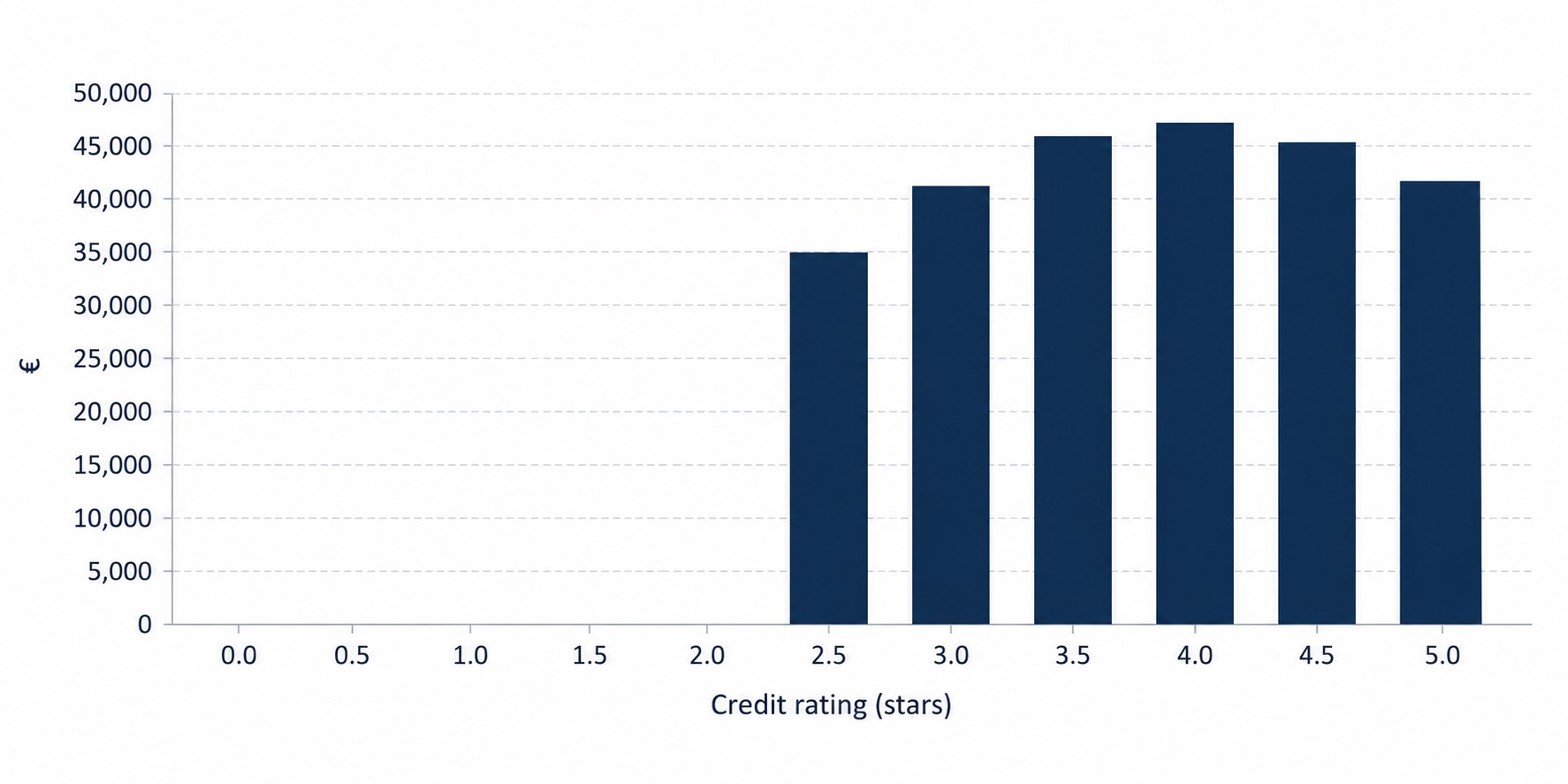
Average recommended credit limit (€) by credit rating. Source: Navigora, April 2021.
The absence of a positive recommendation should not automatically be interpreted as proof that a company is unable to pay. It means that the company does not meet the model’s criteria for recommending short-term credit.
Recommended credit limits in practice
To understand how the calculation works, let’s look at three hypothetical companies using the 2021 methodology.
Example 1: An established company with good creditworthiness
Consider a manufacturing company with the following profile:
Annual revenue: €600,000
Credit rating: 4 stars
Company age: 8 years
Under the documented calculation model, a four-star company older than two years qualifies for a credit limit of 7% of annual revenue.
€600,000 × 7% = €42,000
The resulting recommended credit limit would be €42,000.
This amount provides a reference point for evaluating short-term credit exposure, subject to additional checks and the organisation’s own credit policy.
Example 2: A younger company with the same credit rating
Now consider a company with identical annual revenue and creditworthiness, but a much shorter operating history:
Annual revenue: €600,000
Credit rating: 4 stars
Company age: 1 year
Under the same methodology, a company aged two years or less with a four-star rating qualifies for 2% of annual revenue.
€600,000 × 2% = €12,000
The recommended credit limit would therefore be €12,000.
Although both companies have the same revenue and credit rating, the younger company’s shorter operating history results in a more conservative recommendation.
Example 3: A large company with excellent creditworthiness
Finally, consider an established company with:
Annual revenue: €3 million
Credit rating: 5 stars
Company age: 12 years
At 9% of annual revenue, the initial calculation would produce a credit limit of €270,000.
However, the original methodology included a maximum recommendation of €100,000 for a single short-term credit arrangement.
The recommended amount would therefore be capped at €100,000.
This limit reflected the view that larger credit commitments require a more comprehensive financial assessment rather than relying on an automated recommendation alone.
Why do recommended credit limits vary between industries?
A company’s industry can influence its revenue structure, financial needs and operating conditions.
However, differences in average recommended credit limits do not necessarily mean that companies in one industry are more creditworthy than companies in another.
In Navigora’s historical analysis from April 2021, average recommended credit limits varied across industries.
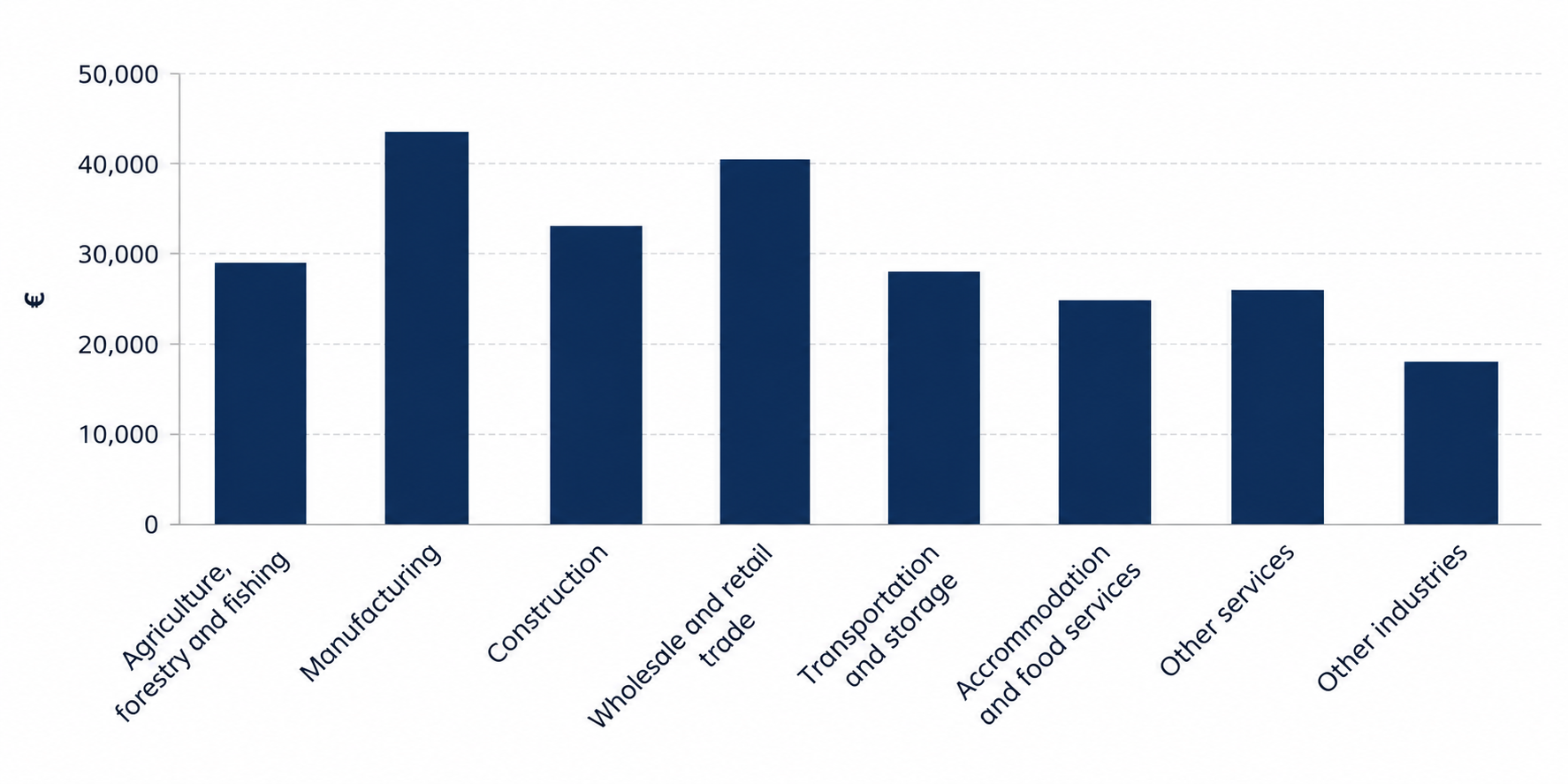
For example:
Manufacturing: €43,453
Trade: €40,449
Accommodation and food services: €24,556
Manufacturing and trade had relatively high average credit limits, while accommodation and food services had a lower average.
These differences partly reflected the size and revenue distribution of companies within each industry.
A sector dominated by smaller businesses may have a lower average credit limit, even if individual companies demonstrate strong financial reliability.
The key takeaway is that a credit limit should be interpreted in the context of the individual company, not simply compared with an industry average.
The figures above describe the situation in April 2021 and should not be treated as current industry benchmarks.
How can businesses use recommended credit limits?
Recommended credit limits are most useful when they become part of everyday business decisions.
Instead of treating the recommendation as a standalone number, businesses can use it as a starting point for managing financial exposure more consistently.
Set more informed payment terms
Offering customers payment terms can support sales and long-term relationships, but it also exposes your business to financial risk.
A recommended credit limit can help determine whether a proposed order or payment arrangement is proportionate to the customer’s estimated repayment capacity.
For customers with greater financial uncertainty, businesses may consider shorter payment terms, partial advance payments or additional checks before approving larger transactions.
Support customer onboarding
Before accepting a new customer, it is useful to understand both their commercial potential and financial reliability.
A recommended credit limit adds another perspective to customer evaluation.
Sales and finance teams can use it alongside credit ratings, financial statements and company information to make more consistent decisions about new business relationships.
Manage accounts receivable
As customer relationships develop, outstanding invoices and credit exposure can increase.
Recommended credit limits provide a reference point when reviewing how much financial exposure is reasonable for individual customers.
For example, if a customer already has a substantial amount of unpaid invoices, approving another large credit purchase may require additional consideration.
A consistent credit review process helps businesses balance commercial opportunities with effective accounts receivable management.
Review credit exposure as companies change
A company’s repayment capacity is not necessarily static.
Revenue may increase or decline, profitability may change and new financial information may become available.
For this reason, credit assessments should be reviewed periodically, especially before significant transactions or changes to payment terms.
With Navigora Signals, businesses can also follow relevant company developments and identify changes that may warrant a closer financial review.
What should you consider before making a credit decision?
A recommended credit limit provides valuable guidance, but it should never be the only factor influencing a credit decision.
The underlying financial information may not reflect events that have occurred since the company’s latest financial statements.
A previously stable company may have experienced declining revenue, liquidity problems or other developments that affect its ability to meet financial obligations.
Before extending credit, consider reviewing:
Latest financial statements: Are the figures recent enough to support the decision?
Profitability and liquidity: Does the company have sufficient financial resources to meet its commitments?
Payment history: Are there payment defaults, overdue invoices or other warning signs?
Existing credit exposure: How much does the company already owe your business?
Order size and payment terms: Does the proposed arrangement create an unusually large exposure?
Recent company developments: Have significant changes occurred since the latest financial reporting period?
It is also important to distinguish between estimated repayment capacity and actual cash availability.
Revenue does not equal cash flow, and even a profitable company may experience short-term payment difficulties.
For larger or more complex credit decisions, additional financial analysis may be necessary.
A smarter approach to credit decisions
The goal of a recommended credit limit is not to eliminate financial risk entirely.
Instead, it is to help businesses understand their exposure, establish consistent credit assessment practices and make better-informed decisions.
By combining credit ratings with annual revenue and company age, credit-limit recommendations add a practical monetary perspective to financial risk evaluation.
They can help businesses set appropriate payment terms, assess new customers and manage accounts receivable without relying entirely on manual financial analysis.
Most importantly, a recommended credit limit is a decision-making tool, not an automatic approval.
When used alongside up-to-date company information and sound business judgement, it can support healthier customer relationships and more responsible credit management.
Want to explore the financial reliability of the companies you do business with?
Read our How-to guide for Navigora Score and discover how Navigora Score helps you assess company creditworthiness and identify potential financial risks.
Make smarter credit decisions with Navigora
Access Nordic company intelligence, financial information and credit risk insights in one place.