



Discover how financial data, machine learning and predictive analytics come together to turn complex company information into a clear, five-star credit rating.
How can you tell whether a company is financially reliable? And how can financial data help predict potential risks before they become serious problems?
Evaluating a company’s creditworthiness traditionally involves reviewing financial statements, analysing financial ratios and examining how its financial position has developed over time.
Navigora Score simplifies this process by combining financial data and machine learning into an easy-to-understand credit rating.
Behind the simple 0–5 star scale is an automated credit assessment model designed to estimate a company’s financial risk and likelihood of bankruptcy.
In this guide, we’ll explore what goes into Navigora Score, how the rating is calculated and what the results reveal about a company’s financial reliability.
What is Navigora Score?
Navigora Score is an AI-powered credit rating that evaluates a company’s financial reliability using financial indicators, historical company data and machine learning.
Creditworthiness describes a company’s ability to meet its financial obligations, including paying suppliers, repaying loans and fulfilling other financial commitments.
Instead of relying on a single financial figure, Navigora Score examines multiple aspects of a company’s financial position to provide a more comprehensive assessment.
The result is presented as a credit rating from 0 to 5 stars, making complex financial information easier to interpret.
A higher rating generally indicates stronger creditworthiness and a lower estimated risk of bankruptcy, while a lower rating suggests that closer financial assessment may be needed.
The rating helps businesses evaluate customers, suppliers and potential partners, supporting more informed decisions without requiring extensive manual financial analysis.
What do Navigora Score credit ratings mean?
Navigora Score uses a five-star credit rating system, with half-star increments to provide a more detailed assessment of financial risk.
Each rating represents a different level of estimated creditworthiness.
| Navigora Score | Creditworthiness |
| 5 stars | Excellent + |
| 4.5 stars | Excellent |
| 4 stars | Good + |
| 3.5 stars | Good |
| 3 stars | Satisfactory + |
| 2.5 stars | Satisfactory |
| 2 stars | Fair + |
| 1.5 stars | Fair |
| 1 star | Poor |
| 0.5 stars | Very poor |
| 0 stars | No creditworthiness |
For example, a company with a rating of 4.5 stars generally has a lower estimated bankruptcy risk than a company with 1.5 stars.
However, the scale is not linear. A company with 4 stars is not necessarily twice as financially stable as a company with 2 stars.
The purpose of the rating is to classify financial risk, not to measure a company’s overall value, commercial potential or future success.
What goes into Navigora Score?
Navigora Score analyses more than 50 financial indicators to evaluate different aspects of a company’s financial position.
These indicators are grouped into five key areas.
1. Profitability
Profitability measures a company’s ability to generate earnings from its operations and resources.
Common indicators include return on equity (ROE), return on investment (ROI), EBITDA margin and net profit margin.
Consistent profitability can indicate financial strength, while declining margins or repeated losses may signal increasing financial pressure.
2. Solvency
Solvency describes a company’s long-term financial stability and its ability to manage debt.
Indicators such as the equity ratio and net gearing help evaluate the company’s capital structure and dependence on external financing.
Companies with stronger solvency generally have greater financial flexibility when facing unexpected challenges.
3. Liquidity
Liquidity measures a company’s ability to meet its short-term financial obligations.
Financial indicators such as the current ratio and quick ratio help determine whether a company has sufficient liquid assets to cover upcoming payments.
Weak liquidity can indicate potential cash flow difficulties, even when a company appears profitable.
4. Financial efficiency
Financial efficiency reflects how effectively a company manages its resources and working capital.
Indicators such as accounts receivable turnover provide insight into how efficiently the company converts its business activities into cash.
Changes in efficiency can reveal underlying financial challenges that may not be immediately visible in revenue or profit figures.
5. Growth
Growth indicators help assess how a company’s business has developed over time.
Revenue growth and changes in employee numbers can reveal important trends in business performance.
Growth alone does not guarantee financial stability, but when combined with profitability, solvency and liquidity, it contributes to a more complete understanding of a company’s financial position.
By analysing these five areas together, Navigora Score provides a broader assessment than any individual financial ratio could offer.
How does machine learning assess financial risk?
At the core of Navigora Score is a machine learning methodology based on XGBoost (Extreme Gradient Boosting).
XGBoost is a predictive modelling technique that uses a sequence of decision trees to identify patterns and relationships within large datasets.
Rather than relying on fixed rules or a simple average of financial ratios, the model learns from historical financial information and observed outcomes.
This allows it to identify combinations of financial characteristics that may be associated with an increased risk of bankruptcy.
The methodology uses up to four financial statements to evaluate not only a company’s current financial position but also how its financial performance has developed over time.
For example, the model may identify patterns involving:
Declining profitability over several financial periods.
Increasing indebtedness.
Weakening liquidity.
Deteriorating financial efficiency.
Changes in revenue or business growth.
These factors are evaluated together to estimate the likelihood of financial difficulties.
Predicting bankruptcy risk over time
Navigora Score’s underlying methodology estimates bankruptcy risk across three time horizons:
1 year: Short-term bankruptcy risk.
2 years: Medium-term bankruptcy risk.
3 years: Longer-term bankruptcy risk.
The model produces probability estimates for each period, helping identify companies with different levels of financial risk.
These predictions are then processed and converted into a standardised credit rating.
From financial data to five stars
The calculation of Navigora Score follows three main stages.
Step 1: Financial data analysis
The system processes available financial statements and calculates more than 50 financial indicators covering profitability, solvency, liquidity, efficiency and growth.
Historical financial information provides additional context about the company’s development.
Step 2: Machine learning predictions
XGBoost-based models analyse the financial indicators and estimate the company’s probability of bankruptcy over one, two and three years.
Quality checks help ensure that only suitable predictions are used in the final assessment.
Step 3: Credit rating calculation
The accepted risk estimates are converted into standardised scores based on their position in the predicted risk distribution of Finnish companies.
These scores are combined and transformed into the final credit rating, rounded to the nearest half-star.
The result is Navigora Score: a clear 0–5 star rating that turns complex financial risk analysis into an accessible business insight.
What does historical data reveal about credit risk?
An effective credit rating system should demonstrate a meaningful relationship between estimated financial risk and actual financial outcomes.
One way to assess this is by examining how companies with different credit ratings performed over time.
According to Navigora’s May 2026 methodology report, historical analysis of Finnish companies shows a clear relationship between star ratings and observed bankruptcy rates.
The analysis examined actual bankruptcies during a two-year follow-up period.
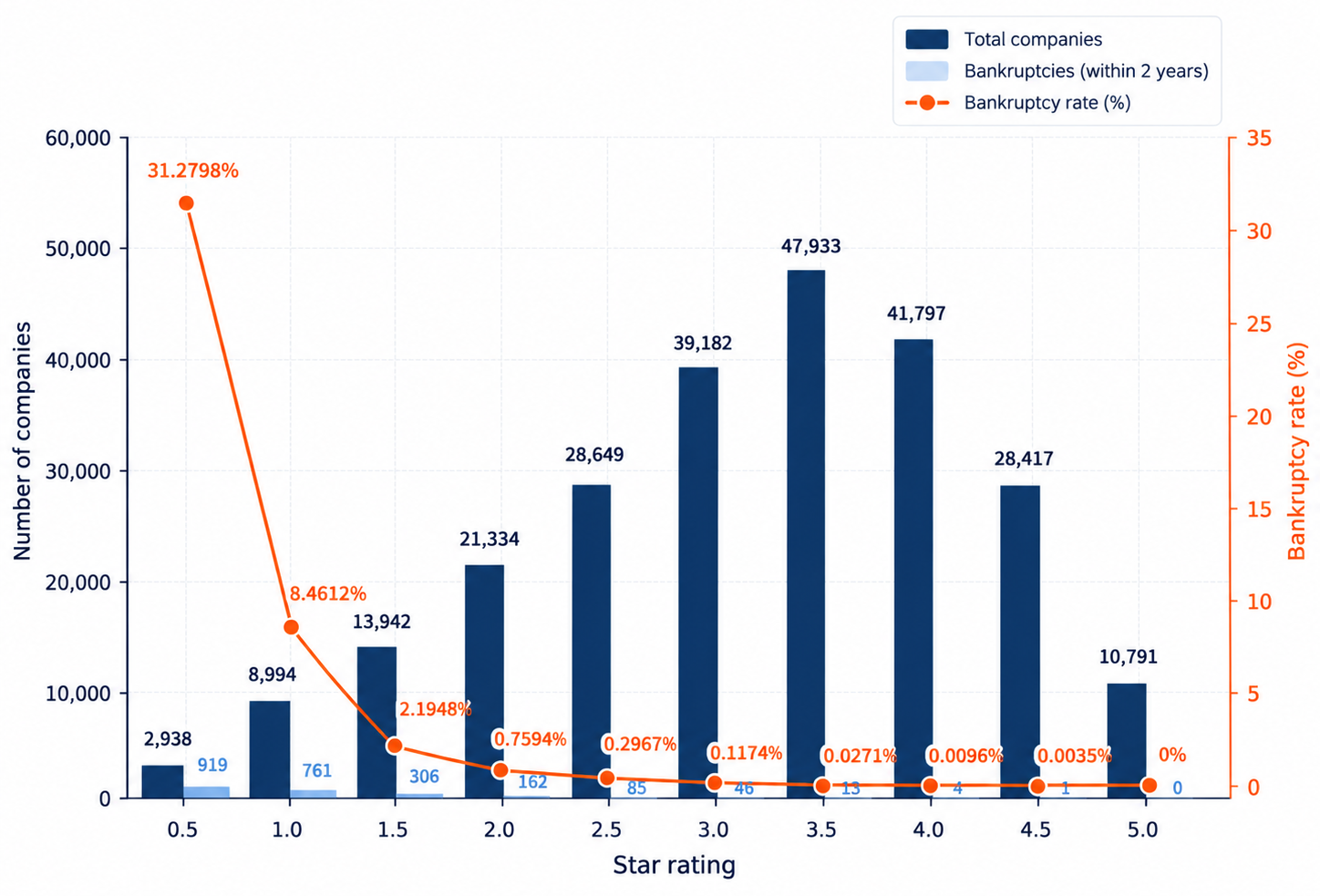
The results included:
Companies rated 5 stars
Among approximately 11,000 companies receiving the highest rating, no bankruptcies were observed during the two-year follow-up period.
Companies rated below 2.5 stars
Observed bankruptcy rates increased considerably among companies receiving lower ratings.
Companies rated 0.5 stars
Approximately 31% of companies in the lowest half-star category went bankrupt during the two-year follow-up period.
| Stars | Total companies | Bankruptcies (count) |
| 5.0 | 10 791 | 0 |
| 4.5 | 28 417 | 1 |
| 4.0 | 41 797 | 4 |
| 3.5 | 47 933 | 13 |
| 3.0 | 39 182 | 46 |
| 2.5 | 28 649 | 85 |
| 2.0 | 21 334 | 162 |
| 1.5 | 13 942 | 306 |
| 1.0 | 8 994 | 761 |
| 0.5 | 2 938 | 919 |
These findings demonstrate that the rating system can distinguish between company groups with substantially different historical bankruptcy outcomes.
However, historical observations should not be interpreted as exact predictions for individual companies.
A highly rated company can still experience financial difficulties, while a company with a low rating may continue operating successfully.
Credit ratings describe estimated risk, not certain future outcomes.
What is the recommended credit limit?
In addition to the credit rating, Navigora’s Finnish credit assessment methodology includes a recommended credit limit.
While Navigora Score indicates the company’s estimated financial risk, the recommended credit limit provides a reference point for evaluating potential credit exposure.
The credit limit is calculated using a separate model that considers three factors:
Credit rating: The company’s Navigora Score.
Annual revenue: The company’s latest available revenue.
Company age: The number of years the business has been operating.
A recommended credit limit is calculated for companies with a credit rating of at least 2.5 stars.
The recommended limit can support decisions about payment terms, customer credit exposure and financial risk management.
However, it should not be treated as a guarantee of payment or an automatic recommendation to extend credit.
Businesses should also consider their own risk policies, current financial information and the nature of the commercial relationship before making credit decisions.
Why should credit ratings be combined with other company data?
Although machine learning-based credit ratings provide valuable insights, no single rating can capture every factor affecting a company’s future.
Navigora Score is based primarily on available financial statements and historical financial information.
This means that recent developments may not yet be reflected in the rating, particularly when significant changes have occurred since the latest financial reporting period.
Younger companies may also have limited financial histories, which can make historical financial assessment more challenging.
For a broader understanding of a company’s situation, Navigora Score can be combined with:
Financial statements: Review revenue, profitability, liquidity and solvency.
Payment information: Identify registered payment defaults and other potential warning signs.
Company comparisons: Evaluate financial performance alongside relevant peers.
Ownership and management information: Understand the people and organisations behind the business.
Navigora Signals: Follow business changes that may indicate emerging risks or opportunities.
Market and industry information: Put financial performance into a broader business context.
Combining these insights helps businesses move beyond a single credit rating and build a more complete picture of potential customers, partners and suppliers.
Better data. Clearer risk assessments. Smarter decisions.
Creditworthiness is an important part of understanding the companies you do business with.
Navigora Score brings together financial indicators, historical company information and machine learning to transform complex financial analysis into a clear and accessible credit rating.
By identifying patterns in financial performance and estimating bankruptcy risk, it provides an additional layer of insight for evaluating customers, suppliers and business partners.
The five-star scale makes financial risk easier to understand, while the underlying methodology provides a data-driven foundation for more informed decisions.
Want to put Navigora Score into practice?
Read our guide, How to use Navigora Score, to discover how credit ratings can support prospect qualification, company comparisons and everyday risk assessment.
Turn financial data into better business decisions
Explore Navigora Score and discover a smarter way to evaluate company creditworthiness.